Cape Town
(Part 1)
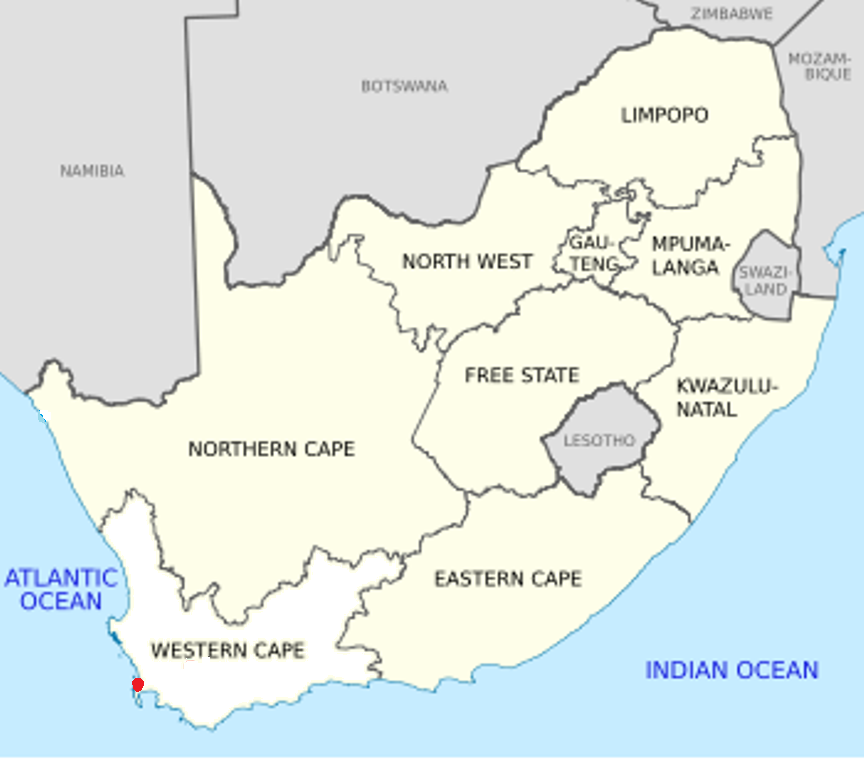 |
| Location of Cape Town in South Africa! |
Goeie dag!
Dumela!
Sanibonani!
Molo!
Thobela!
Lumela!
Abusheni!
Hello!
Sanibona!
Avuwani!
Salibonani!
…and welcome to the ‘friendly city’!
 |
| Cape Point, where the Atlantic- and Indian Oceans meet! |
Established in 1652 by Jan van Riebeeck from The Netherlands, the city has developed over the centuries as a major commercial and industrial centre! The Cape Town harbour in Table Bay has become one of Africa’s leading export centres and is home to the Victoria and Alfred Waterfront.
The city is instantly recognisable by South Africa’s first and only World Wonder, Table Mountain that can be seen up to distances of 80 kilometres away! Cape Town is also the administrative-capital of South Africa and is located in the province of the Western Cape.
The city is instantly recognisable by South Africa’s first and only World Wonder, Table Mountain that can be seen up to distances of 80 kilometres away! Cape Town is also the administrative-capital of South Africa and is located in the province of the Western Cape.
 |
| Cape Town Harbour! |
This cosmopolitan city, offers a variety in attractions that ranges from sandy beaches, slave houses to natural icons. One of the most famous cultural attractions the city has to offer is the, Castle of Good Hope that was built by Jan van Riebeeck in 1666-1679. The ‘castle’ was used to store food and supplies for all boats travelling around the southern tip of Africa in the 15th to 17th centuries.
This pentagon shaped fort is also known for the ‘Noon Gun’ that was originally used to signal the correct time of day to ships anchored in Table Bay, the ‘Noon Gun’ is still in use today, and is shot daily at 12:00, the shot can be heard throughout Cape Town. This activity has become a tradition in Cape Town.
Guided tours through the ‘castle’ are available with tourism-companies across Cape Town and points of interest on the tour in the ‘castle’ include going down into the dungeon of the ‘castle’ that is reportedly haunted by slaves who died their during the centuries.
This pentagon shaped fort is also known for the ‘Noon Gun’ that was originally used to signal the correct time of day to ships anchored in Table Bay, the ‘Noon Gun’ is still in use today, and is shot daily at 12:00, the shot can be heard throughout Cape Town. This activity has become a tradition in Cape Town.
Guided tours through the ‘castle’ are available with tourism-companies across Cape Town and points of interest on the tour in the ‘castle’ include going down into the dungeon of the ‘castle’ that is reportedly haunted by slaves who died their during the centuries.
 |
| The Castle of Good Hope, this pentagon shaped fort was built in 1666-1679. |
 |
| The 'Noon Gun', was originally used to signal the time of day to boats loacted in Table Bay, the 'Noon Gun' is still in use today and is shot daily at 12:00! |
Other cultural destinations in Cape Town that can be visited include: The Slave Lodge on Adderley Street. This ‘slave lodge’ was built in 1679, and was the home of slaves brought from Malaysia and West- and East Africa. The ‘lodge’ was later converted into the Cape Supreme Court, but in recent years was transformed into a museum. The way of life of the slaves brought to the Cape can be viewed in the museum.  |
| The entrance to the Castle of Good Hope! |
 |
| The dungeon of the Castle of Good Hope, located in Cape Town! |
 |
| This dungeon is said to be haunted by the slaves who died there, through the centuries... |
 |
| The Museum, was once a 'Slave Lodge' and Cape Supreme Court. |
Another place of interest is District Six- this neighbourhood depicts the life of the once vibrant community, removed by the Group Areas Act 1966 during the apartheid-era. People from other races that were not white, where moved to the harsh environment of the Cape Flats on the outskirts of Cape Town far away from the central economic city.
The area of District Six was proclaimed a white neighbourhood by the National Party who ruled from the beginning of apartheid (1948) to the ending of it in 1994, when the first democratic election took place. All people from a different race had to be evacuated to the Cape Flats because they were not following the law if they continued to stay in District Six. This area is one of few in South Africa showcasing the battles fought, for equal treatment among different races in South Africa. The District Six Museum showcases the way of life in District Six before the people of the community were evacuated.
The area of District Six was proclaimed a white neighbourhood by the National Party who ruled from the beginning of apartheid (1948) to the ending of it in 1994, when the first democratic election took place. All people from a different race had to be evacuated to the Cape Flats because they were not following the law if they continued to stay in District Six. This area is one of few in South Africa showcasing the battles fought, for equal treatment among different races in South Africa. The District Six Museum showcases the way of life in District Six before the people of the community were evacuated.
 |
| This museum depicts the life of the once vibrant community, of District 6! |
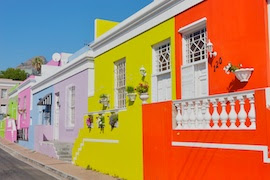 |
| Restored houses of the once vibrant community of District 6, these houses of former District 6 residents are managed and maintained by the Ditrict Six Museum! |
 |
| Cover of the brosjure of the District Six Museum, where the battles faught for equal human rights are displayed and described in detail! |
 |
| This example of a sign out of the apartheid-era, can be seen in the District 6 Museum! The sign indicates people who were not a certain race, could not enter the facilities. |
 |
| The harsh environment of the Cape Flats, where the former inhabitants of District 6 where moved by the National Party's, Group Areas Act of 1966. |
Some other places worth visiting is the Bo-Kaap Museum, The Gold of Africa Museum, the Koopmans de Wet House and the Michaelis House, that became the first town hall in South Africa in 1840- all of these attractions showcase the starting point of the Cape Town we know and love today!
 |
| The Bo-Kaap Museum! |
 |
| Michaelis House, this house became the first town hall in South Africa in 1840. |
 |
| The Koopmans de Wet House! |
 |
| The Gold of Africa Museum! |
Another attraction located in the Cape Town harbour is the- Victoria and Alfred Waterfront (V&A). Located within this breath taking setting of this dynamic working harbour, the V&A Waterfront includes over 400 specialist stores and more than 70 restaurants- ranging from South African chain restaurant to fine dining restaurants.
The V&A Waterfront also offers the choice of world class conference- and hotel facilities. All of these facilities combined with on-going event and entertainment with a vibrant cosmopolitan atmosphere, ensures that the V&A Waterfront is the heart of any visit to Cape Town. There nothing more satisfying as drinking an ice cold glass of South African white wine, sitting on the balcony of one of the many restaurants and looking out over the two oceans and seeing Robben Island in the distance, definitely a sight to treasure forever.
The V&A Waterfront also offers the choice of world class conference- and hotel facilities. All of these facilities combined with on-going event and entertainment with a vibrant cosmopolitan atmosphere, ensures that the V&A Waterfront is the heart of any visit to Cape Town. There nothing more satisfying as drinking an ice cold glass of South African white wine, sitting on the balcony of one of the many restaurants and looking out over the two oceans and seeing Robben Island in the distance, definitely a sight to treasure forever.
 |
| The Victoria & Alfred Waterfront (V&A), located in Cape Town Harbour. |
A key festival taking place every year on the 2nd of January, and referred to by Capetonians as the ‘second New Year’ is the, festival of the “Kaapse Klopse”!
This event involves around 13 000 people divided into different groups among neighbourhoods or families, mostly from the coloured Afrikaans working class families, all dressed in costumes with bright colours and dancing with umbrellas, singing South African folk-songs or playing a variety of musical instruments, through the streets of Cape Town on the way to the Green Point Stadium-track where the main event of seeing all the different groups together takes place.
 |
| All the people participating in the "Kaapse Klopse", are dressed in customes that are made of bright florescent colours! |
This Malay tradition has been carried on since 2 January 1834, as a celebration of the ending of slavery. Slavery was officially abolished in the Cape on the 1st of December 1833. For everyone visiting Cape Town, this event and all the activities taking place with it is a must see! The “Kaapse Klopse” festival is one of the biggest events in South Africa yearly…
 |
| This Malay tradition has been carried on since 2 January 1834, as a celebration of the ending of slavery on 1 December 1833. This festival is also referred to as the 'second New Year'! |
 |
| 13 000 People are divided into different groups among neighborhoods or families, and either dnace with umbrellas, sing South African folk-songs or place a variety of musical instruments. |
Part 2 of Cape Town coming soon…
Till next time…
C.R.